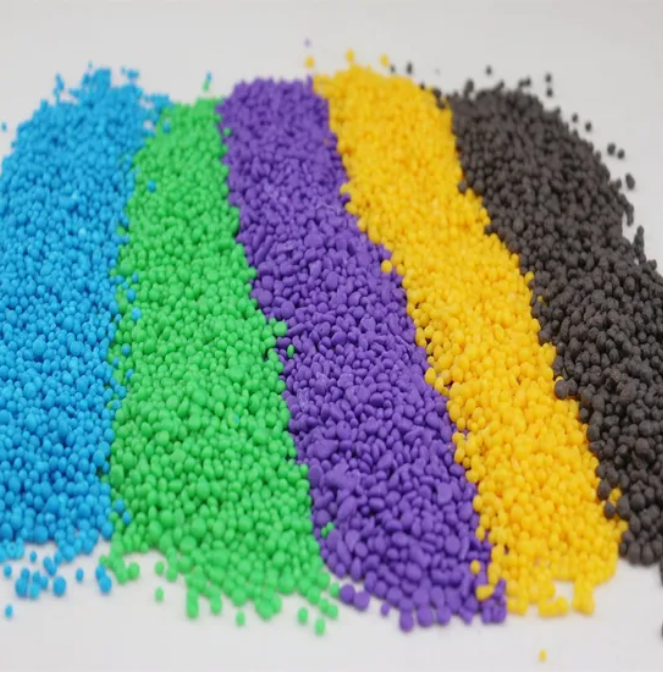
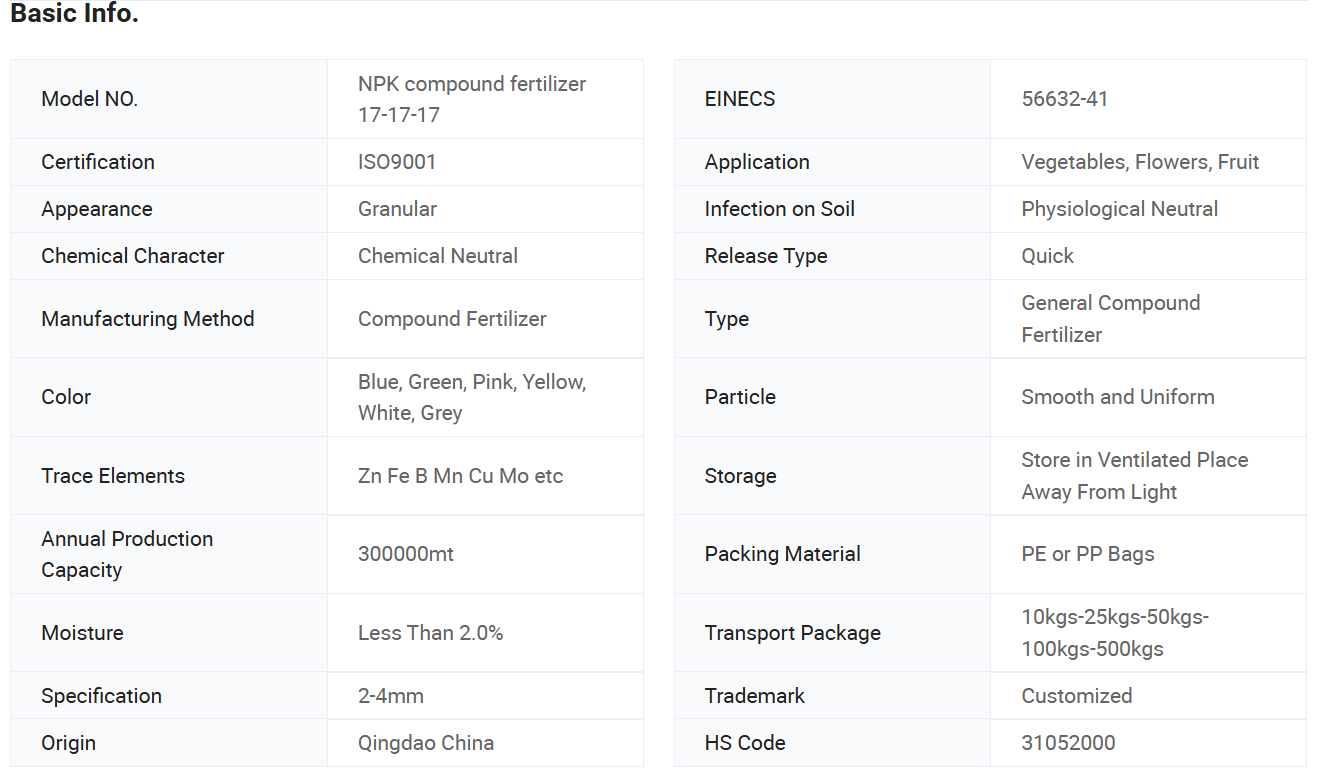
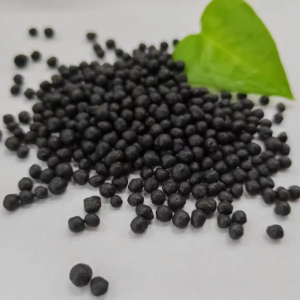
NPK compound fertilizer
as a widely accepted and applied compound fertilizer, integrates the main three elements of nitrogen, phosphorus and potassium.
1.Nitrogen
It is the basis for proteins in plants and animals, and is present in the chloroplasts, which are the molecules within plants that perform photosynthesis, making food for the plants.
2.Phosphorus
Phosphorus is often referred to as “The Energizer” for its role in converting the sun’s energy into food, fuel and fiber.
3.Potassium
Potassium is one of the three primary crop nutrients required for plant growth. Potassium serves as the “Regulator” of many essential processes within the plant.
CERTIFICATE OF ANALYSIS
Commodity: NPK 17-17-17
| Item | Standard | Test Result |
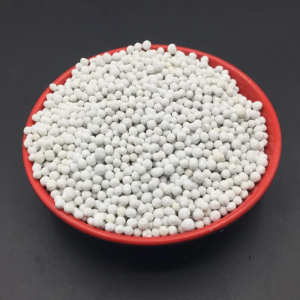
| Appearance | High Tower Granular | High Tower Granular |
| Size of Granular | 2-4mm | complied |
| Total Nitrogen(N) | 17% | 17% |
| Available Phosphorous (P2O5) | 17% | 17% |
| Potash (K2O) | 17% | 17% |
| Moisture | ≤2.0% | 0.7% |
| Fe | 100ppm | complied |
| Mn | 100ppm | complied |
Benefits of 17-17-17
It is an excellent formulation of Nitrogen, Phosphorus and Potassium required for multiple functions in the entire plant. 17-17-17 ratio of NPK makes it perfectly balanced and versatile and makes it able to be used at the entire lifecycle of plant.
Nitrogen is essential component of amino acids and photosynthesis, phosphorus encourages the deep root growth and promotes blooming, and potassium increases the crop resistance to cold and drought, as well as its I required for various metabolic activities and enzyme activation.
It is soluble in water and can be applied as foliar or drip irrigation application, it can be mixed with other fertilizers except calcium-based fertilizer.
1) The particles are small, uniform, and not easy to harden.
2) The product quality is stable, easy to distinguish from ordinary fertilizers, and has a high degree of identification.
3) Low water content, good water solubility, fast melting speed, suitable for cultivation in various facilities.
4) Nutrients are evenly distributed, which improves the utilization rate of fertilizers and significantly increases production and income.
5) Rich in nitrate nitrogen and ammonium nitrogen, it dissolves quickly, absorbs quickly and takes effect quickly.
6) The production process is clean, green, and environmentally friendly.
The difference between SOP (Potassium Sulphate) based fertilizer and MOP (Potassium Chloride) based fertilizer:
Potassium sulfate (K2SO4) and potassium chloride (KCl) are two common potassium fertilizers that have some differences in their chemical composition and mode of action.
Chemical composition: Potassium sulfate: Potassium sulfate contains potassium (K) and sulfur (S), of which the content of potassium is usually higher, is one of the main components of potassium sulfate fertilizer. Potassium chloride: Potassium chloride contains potassium (K) and chloride (Cl), of which the content of potassium is also higher, is one of the main components of potassium chloride fertilizer.
Mode of action: Potassium sulfate: Potassium sulfate provides two essential elements of potassium and sulfur for plants to absorb and use. Potassium is a key element needed for plant growth and development, promoting root development, improving disease resistance and increasing yield. Sulfur also plays an important role in protein synthesis, plant growth and nutrient absorption. Potassium chloride: Potassium chloride also provides potassium for plants to absorb and use. Chloride plays an important role in photosynthesis and ion balance in plants, but not all plants have the same requirements for chloride. Some plants are allergic or intolerant to chloride, so potassium chloride may not be the preferred potassium fertilizer in these cases.
Soil and crop suitability:
Potassium sulfate: Potassium sulfate is suitable for most soil types, especially alkaline soil, because potassium sulfate can also help improve the acidity of the soil. It is suitable for many crops, including grains, vegetables, fruit trees, etc.
Potassium chloride: Potassium chloride dissolves easily in soil and is suitable for a variety of soil types. It is also suitable for many crops, including corn, potatoes, vegetables, etc. However, for some chlorine-sensitive crops (such as strawberries, peanuts, etc.), the use of potassium chloride may need to be cautious.
There are some differences between potassium sulfate and potassium chloride in chemical composition, mode of action and applicability. When choosing which fertilizer to use, you need to consider the chloride requirements of the plant, the soil type and other factors.
Nitro-compound fertilizer is a high-concentration N, P and K compound fertilizer produced by adding phosphorus, potassium and other compound fertilizer materials with ammonium nitrate as nitrogen source. Its products contain both nitrate and ammonium nitrogen. The main products are ammonium nitrate phosphorus, ammonium nitrate phosphorus potassium.
Nitro-compound fertilizer is an important agricultural fertilizer, which is mainly suitable for cash crops such as tobacco, corn, melons and fruits, vegetables and fruit trees, as well as alkaline soil and karst landform areas, and its application effect is better than urea in alkaline soil and karst landform areas.
Different plants have different preferences for nitrate and ammonium nitrogen. Calcium-loving plants that are suitable for growing on calcareous soil with high pH value preferentially use nitrate nitrogen, such as corn and most vegetables, cotton, tobacco, fruit trees, etc., are also cash crops that prefer nitrate nitrogen. Calciphobe plants suitable for acidic soil and plants suitable for low REDOX potential soil are fond of ammonium nitrogen. Under the condition of controlling the ratio of different nitrate nitrogen and ammonium nitrogen, the vegetable cultivation experiment was carried out. The relative yield of all nitrate nitrogen was 100%. When the ratio of ammonium nitrogen exceeded 30%, the vegetable would be reduced, and the yield of all ammonium nitrogen was less than 20% of all nitrate nitrogen. In the book Vegetable Cultivation in China, it is clearly pointed out that “vegetables are nitrin-tolerant crops, and when the amount of ammonium nitrogen exceeds 50%, the yield of onion decreases significantly, while spinach is more sensitive to ammonium nitrogen and has the highest yield under the condition of 100% nitrate nitrogen.”
Be the first to review “Mop/Sop Based NPK Compound Fertilizer 17-17-17”
Related products
Reviews
There are no reviews yet.